Ships of War—1782—False Colours
READ REVIEWS

2025 HFC BOOK AWARDS
SEMI FINALIST
5 STARS
REVIEW
There are books that open not with a shout but with a slow, inexorable heave—like a wave lifting the reader from the solid earth and setting them adrift upon its pulse. Bradley John’s Ships of War — 1782 — False Colours is such a book.
One scarcely turns a page before the deck tilts, the rigging hums, and the great, salt-creased body of the sea begins its murmuring. So persuasive is John’s conjuring that the ordinary world, with its quiet comforts and landlocked certainties, falls away; one steps instead into that floating realm where men are tested against wind, against cannon, against the shadowed chambers of their own hearts.
It is not the battles alone that hold us—though they rumble in the distance like storms gathering their breath—but the strange, intimate theatre of life aboard the Hinchinbrook. The ship seems a creature in herself, stitched together by groaning beams and shivering canvas, ever alert to the whims of tide and temperament. Bradley John’s prose, at once steady and quietly glowing, traces these motions with the precision of a mariner and the sensitivity of one who has listened long to the sea’s secret voice. Every detail rings: the sting of brine on a young boy’s cheek, the whispered dread that passes among men confined within timber walls, the thin, glimmering line between obedience and despair.
At the heart of this floating world stands Captain Francis Eugene Ryan, a figure whose presence one feels as one might sense a sudden change in weather: the air tightens, the light shrinks, something unseen sharpens its claws. He is not wicked in the melodramatic fashion of lesser tales; instead, his cruelty is of that insidious, drifting sort that settles over the deck like fog—thick, choking, impossible to ignore. Under his gaze even the most seasoned sailors seem to grow smaller, as if carved down by silence and dread.
Opposite him—though never openly, for aboard a king’s ship truth must tread softly—moves First Lieutenant Joseph William Adams. Adams’s virtues are not the noisy ones; rather, he stands with a quiet gravity, a steadiness that feels all the more luminous for the shadow thrown upon it. There is a poignancy in his restraint, a tension in every measured word he speaks to his captain, as though the very timbers of the ship creak in sympathy with the strain between them.
Around these two poles spins the crew, each man a world unto himself. We are given only brief glances—yet how those glances linger. The suffering of young Jenkins, pale as morning light and twice as fragile, strikes with the force of a blow. One feels the injustice ripple outward, unsettling even the hardened sailors who know too well the cost of protest. And then there is Cooper, whose path becomes entwined with that of Hiro—Hiro with the curious laugh, the quicksilver loyalty, the gentle hands capable of sudden, astonishing ferocity. How strangely tender their bond seems amid the crash of waves and the bark of orders. In Hiro’s presence the novel gathers a warmth, a flicker of humour, like a lantern swinging to life in a storm-dark cabin.
What Bradley John achieves, with a deftness that seems almost effortless, is the sense that each man lives not upon the surface of the sea but within it—caught, buoyed, battered by forces larger than any single will. Tension accumulates in the quiet spaces: in the measured tread along the quarterdeck, in the hush that precedes a flogging, in the distant silhouette of sails whose colours tell no truth. It is a fear that does not shout but shivers, threading itself through thought and breath, settling into the bones.
Yet for all its darkness, for all its scrutiny of power misused and obedience ground into endurance, the novel never relinquishes its humanity. The moments of fellowship—rare, glinting, precious—shine all the brighter for the gloom that surrounds them. And always the sea bears witness, vast and indifferent, its waves rising and falling as they have for centuries, swallowing secrets, revealing others, urging men onward toward trials they scarcely can name.
Bradley John has fashioned more than a tale of war at sea; he has given us a meditation on duty, courage, and the fragile rebellion of the soul when pressed too far. The book lingers long after its final page, like the aftertaste of salt on the lips or the memory of a lantern’s glow in the dark belly of a ship.
A story to be read. A story to be felt. A story that returns, again and again, like the sea itself—unyielding, haunting, and magnificently alive.
Five Stars from The Historical Fiction Company and the “Highly Recommended” Award of Excellence!


YARDE BOOK REVIEWS
5 STARS
REVIEW
“Ships of War — 1782 — False Colours” by Bradley John is a bold and atmospheric return to the tumultuous years of the Age of Sail, delivered with a storyteller’s confidence and a historian’s discerning eye.
From the very first page, the reader is plunged into a world of creaking decks, salt-stung wind, and the shifting loyalties that define existence aboard a man-of-war. Bradley John writes with a clarity and immediacy that honours the finest seafaring traditions while establishing a distinctive narrative voice of his own. This is not merely a tale of broadsides and manoeuvre, but a profoundly human story—of command stretched to breaking, of quiet courage in the face of tyranny, and of the fragile bonds that hold a crew together when duty demands sacrifice.
In this richly imagined narrative, the world aboard the Hinchinbrook rises from the page with striking authenticity. The wind-whipped sails, the creak of timber, and the ever-present promise of peril and reward lend the story a visceral immediacy that is impossible to ignore.
Bradley John’s command of atmosphere is exceptional; every line feels steeped in salt spray and expectation. The sea itself becomes a living, breathing presence—both companion and adversary—shaping the men who serve upon it. With deft prose and an unwavering eye for historical nuance, Bradley John invites readers into a world governed by wind, weather, and the uncompromising discipline of naval life. This is storytelling that honours the age of sail whilst delivering a narrative experience that feels breathtakingly real.
At the narrative’s centre lies a compelling exploration of power, duty, and the quiet rebellions born of injustice. Captain Francis Eugene Ryan is a striking creation—volatile, unpredictable, and chillingly indifferent to the welfare of those under his command. His arbitrary punishments, wilful blindness to danger, and disregard for the rules of war cast a long, oppressive shadow over the Hinchinbrook. The tension he cultivates spreads across the deck like a gathering storm. Opposing him stands First Lieutenant Joseph William Adams, a voice of steadiness, integrity, and quiet resilience. Their exchanges—each clipped phrase and forced courtesy—are sharpened by a powerful undercurrent of conflict.
The supporting cast deepens the novel’s emotional resonance. The suffering of young Midshipman Jenkins is particularly disturbing, a stark reminder of the absolute authority a captain wielded and the vulnerability of boys thrust into a man’s world. Cooper’s storyline adds yet further dimension. His bond with Hiro—a seemingly gentle, devoted survivor he rescued from a burning sea—introduces themes of loyalty, cultural divide, and the unspoken debts born in moments of peril. Hiro is an extraordinary presence: humorous, steadfast, and delightfully unpredictable. His unexpected appearance in Captain Jean François de Galaup, comte de Lapérouse’s armoire is one of the novel’s most amusing moments, though it is his formidable fighting prowess that repeatedly turns imminent disaster into hard-won victory.
Bradley John’s portrayal of the broader crew is equally impressive. Each man carries his own story, his own scars—some worn openly, others buried beneath layers of discipline and obedience. These glimpses into their private struggles and fleeting moments of camaraderie give the Hinchinbrook a vivid, lived-in quality. Even minor figures such as Bull are drawn with an economy of detail that makes them linger long after their scenes have passed, their fates contributing to the broader tapestry of shipboard life.
The narrative excels at building tension, both through its taut dialogue and its carefully orchestrated sequences. The flogging of Jenkins, the simmering unrest among the crew, the ominous appearance of unknown sails—all combine to create a mounting sense of dread. Bradley John captures with great skill the claustrophobic atmosphere of a vessel commanded by an unstable leader, and the reader feels acutely the sense that catastrophe is poised to break at any moment. The mood remains hauntingly consistent: dark, foreboding, and charged with the unspoken fear of men trapped between the sea’s caprice and their captain’s tyranny.
“Ships of War — 1782 — False Colours” by Bradley John is a powerful and compelling tale, beautifully anchored in its period and unafraid to explore the darker currents of command and conscience—this is a story that deserves to be read, remembered, and recommended.
5 stars from Mary Anne Yarde
Yarde Book Reviews & Book Promotion

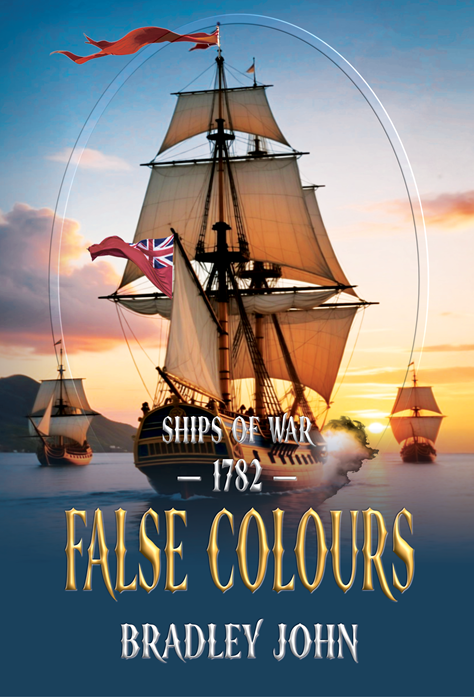
1782 — The The American Revolutionary War rages in the Caribbean. With designs upon the island of Jamaica, the French plan their invasion. England’s lucrative trade is at risk, her lifeblood, the entire war hanging in the balance…
Admiral de Grasse readies the French fleet upon Martinique, soon to depart with over sixty ships and forty thousand troops. To the south the British fleet hovers, Admiral Rodney eagerly waiting upon news from his lookout squadrons.
His Britannic Majesty’s Ship Hinchinbrook, twenty-eight gun, is hurriedly recalled from the repair docks to join the scouting efforts. Their duty to spy the French fleet is clear, to be prosecuted at all costs. Headed about Martinique, the seas of the Windward Islands swarm with enemy shipping, shipping which is hunting day and night. Tensions are high.
A young up-and-coming officer, Midshipman Hayden Reginald Cooper, eagerly awaits news of his examination for lieutenant. The spoils of promotion, prizes and glory await, all amidst the threat of hurricane, destruction and worst of all, abject failure. Should the French slip away unnoticed, Jamaica would be lost, the sugar trade would be lost, the Leeward Islands would be lost and the war would be lost. Hinchinbrook may only be one ship and yet upon her decks the fate of the entire West Indies is poised. Much is at stake and never have so many relied upon those so few…
“False Colours” marks the beginning of Hayden Reginald Cooper’s journey and his adventures in the Royal Navy…