Ships of War — List of Books
ABOUT THE SHIPS OF WAR SERIES
"Ships of War" commences in 1782 at the end of the American Revolutionary War. However, it is predominantly a naval adventure fiction series intended to span the length of the French Revolutionary Wars (1793-1815). This of course is the much loved genre which includes the thundering Hornblower series by C.S. Forester, the Aubrey-Maturin series by Patrick O'Brian and the popular "Master and Commander" blockbuster by Peter Weir. Owing to Bradley John's English heritage, no guesses are needed to determine which side the book's heroes will sail upon…
KEEP READING...
“Ships of War—1782—False Colours”
The Ships of War series centres around the adventures of Hayden Reginald Cooper, an officer in the Royal Navy. We firstly join Cooper in “Ships of War—1782—False Colours”, set in the West Indies within the turmoil of the American Revolutionary War. Dark times forebode, England’s sugar trade at risk, her economy soon to be crippled. A battle of great significance is looming, the Windward and Leeward Islands to be defended at all costs. Our young up-and-coming protagonist, a midshipman barely nineteen years old, tediously awaits the results of his Examination for Lieutenant. Transferred from Flag of the Fleet, Formidable, he is commissioned aboard His Majesty’s Ship Hinchinbrook, a twenty-eight gun frigate charged with scouting the French fleet. It is a shorter narrative, somewhat tumultuous and naturally spiced with battle.
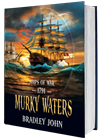
“Ships of War—1791—Murky Waters Rising"
Enter “Ships of War—1791—Murky Waters Rising": it is now 1791 and Cooper’s adventures continue in England whereupon it is a time of peace, yet hardly peaceful. Unemployed, beached on half pay, times are difficult. However, it seems war is coming. Europe is in turmoil. French piracy is rampant. It is everything for which a British sailor could have hoped, the chance for employment, promotion and adventure. May I impart that “Ships of War—1791—Murky Waters Rising” is, of course, an adventure. However, unlike False Colours it is moreover a journey, the graduation of a lowly lieutenant morphing into a gallant commander, though hardly smooth sailing. The narrative commences in Portsmouth, whereupon employment is handsomely offered to Cooper, a long time coming. It is the birth of his first command, may it ever continue and may it hopefully lead to another. It is potentially the greatest risk of his entire career. He must perform. Yet he is verily left to his own devices, tasked with overcoming a great many obstacles, even just to put to sea. Dry land, it seems, is a place no safer than the countless perils of the Channel. Bereft of officers, jacks and men, he must build his command from the ground up. Agamemnon, his commission, lies in mothballs, though she be grand. By and by, forced to navigate the machinations of the Admiralty, it becomes clear he has been thrown to the wolves. With the Tories and Whigs at odds, vultures circling, he soon comes to appreciate the nozzles of enemy cannon staring back, a much-preferred saving grace. It seems a captain’s life is wholly different to that of a simple officer — “be careful what you wish for” coming to mind. And if his tasks to put to sea were not already proving arduous enough, he is suitably awakened to find a wave of French spies brewing.
In this, the narrative has been split into four distinct parts, four distinct stages marking Cooper’s first command. It will soon become apparent that his commission to fight piracy inevitably leads to one pirate in particular, our story’s antagonist. Yet who is the hunter and who is the hunted? Each distinct stage urges the narrative to build, each with its own resounding climax. Hand in hand we accompany Cooper, through 1791 and on into 1792, sharing all the adventure and action, finally culminating in a grand showdown.
In stark contrast to False Colours, Murky Waters Rising is intended to be lengthy. We are afforded breathing space to absorb the stark reality of what is at stake, to gather insights into the background, to immerse ourselves within the period in time. Notably, we will share the depths of Cooper’s angst, perhaps in a more personal way, almost as one of his officers. In addition, this edition has been somewhat updated with enhanced descriptions, including helpful explanations of the seafaring terms. May our landsmen truly enjoy the narrative without being lost at sea.
From time to time the style of writing in the Ships of War series includes “atmospheric writing”, a literary technique attempting to create an immersive emotional mood within the narrative, hopefully drawing the reader into the story’s world by evoking imagery and visualisation distinct to the reader’s experience. An extended example of this is the Prologue (“Ships of War—1791—Murky Waters Rising"), the very first scene of action at sea. In addition, the writing style includes dialogue consistent with the era, sometimes lacking in grammar, yet serving to shape our impression of each character. Rest assured, phrases and words no longer commonly spoken are subtly explained, ensuring fluidity. There is also a detailed Glossary after the Epilogue, an appendix which includes a host of ancient terms, seafaring and otherwise, worth a hearty look.
“Ships of War—1791—Murky Waters Rising" most importantly introduces the main characters who will sail forth into the French Revolutionary Wars, origins and backstories included, setting up the many adventures yet to be shared. May the reader find action, conflict, as well as battles at sea within each part, though the heftiest left to last. May our favourite characters live to see the end, we can only hope…
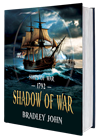
“Ships of War—1792—Shadow of War"
Enter “Ships of War—1792—Shadow of War", which follows on from the previous instalment, thrusting Cooper and his band of merry brothers into the throes of the French Revolution. With war still yet to be declared, shenanigans and mischief go hand in hand with this adventure, Hayden Reginald Cooper leading them into the Mediterranean on even onto the mainland of France...
And is there more...? Currently, in progress, is the next instalment: “Ships of War—1793—At War".
A series by bradley john